Self-Publishing vs. Traditional Publishing in 2026: Which Is Right for You?

Featured Posts

Key Takeaways:
- Self-publishing is faster: weeks to months, versus 2–4 years for traditional deals.
- Self-published authors keep 35–70% royalties; traditionally published authors typically keep 10–15% on print and around 25% on ebooks.
- Traditional publishing pays an advance upfront; self-publishing does not, but you keep every dollar of royalties from day one.
- Self-publishing requires you to fund production (editing, design, formatting) yourself, typically $500–$5,000+.
- Traditional publishers still offer the strongest path to mainstream bookstore shelf space and major media coverage.
- You retain full IP ownership when you self-publish; traditional contracts typically transfer or license rights to the publisher.
- Neither path is “better” the right choice depends on your timeline, genre, and goals for the book
Quick Answer: Self-publishing gives authors full creative control, royalties of 35–70%, and a release timeline of weeks. Traditional publishing offers prestige, editorial support, and advance payments of $5,000–$50,000+, but takes 2–4 years and pays only 10–15% in royalties. Most first-time authors in 2026 choose self-publishing for speed, control, and higher long-term earnings but the right answer depends on your goals, not a universal rule.
Every year, thousands of finished manuscripts sit untouched because their author got stuck on one decision before ever querying an agent or hitting “publish” on Amazon which publishing path actually fits their book. Self-publishing isn’t the consolation prize it used to be, and traditional publishing isn’t the guaranteed ticket to bestseller status most authors assume both can build your name and your bank account, but only if you pick the one that matches what you’re actually trying to accomplish, not the one that sounds more prestigious.
Here’s the honest breakdown of what each path really costs you in time, money, and control.
At Nexell Book Writing, this is the single most common question we hear from first-time authors, and it’s worth answering properly rather than picking a side. Here’s the honest, side-by-side breakdown.
What Is Traditional Publishing?
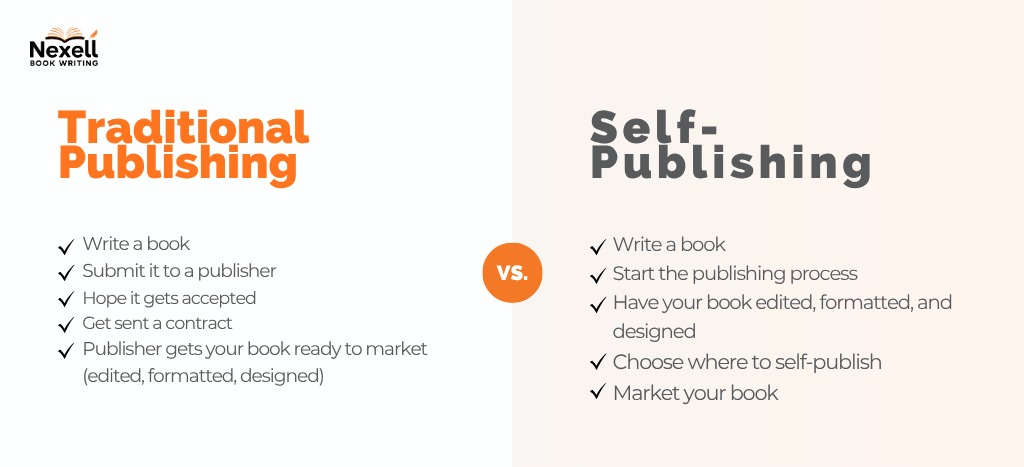
Traditional publishing means signing a contract with a publishing house that handles editing, design, distribution, and marketing of your book. In exchange, the publisher takes a significant share of rights and revenue.
The typical path complete your manuscript, query literary agents, secure representation, submit to publishers, receive and negotiate an offer, sign a contract, then wait 12–24 months for your book to reach shelves. If you’re early in this process, our guide on how to get a literary agent walks through query letters and realistic timelines in more detail.
Advantages of Traditional Publishing
- Credibility and prestige bookstore placement, media coverage, award eligibility
- Editorial, design, and marketing resources provided at no upfront cost to you
- Advance payment of $5,000–$50,000+ for new authors against future royalties
- Wide physical distribution through retail chains and libraries
Disadvantages of Traditional Publishing
- Extremely competitive most manuscripts are rejected even with an agent
- Long process 2–4 years from finished manuscript to published book
- Low royalties typically 10–15% of cover price on print, around 25% on ebooks, per standard industry royalty structures recommended by the Authors Guild
- Limited creative control over title, cover, editing decisions, and release timing
💡 PRO TIP: Query agents in batches of 8–10 rather than one at a time. This lets you revise your pitch based on real feedback without losing months between rounds querying one agent at a time can turn a 2-month process into a year.
What Is Self-Publishing?
Self-publishing means you control and fund the entire production and release of your book. Platforms like Amazon KDP, IngramSpark, and Kobo Writing Life allow any author to publish print and digital books and sell them worldwide without a publisher as gatekeeper.
Advantages of Self-Publishing
- Full creative control over every aspect title, cover, content, pricing
- Royalties of 35–70% on digital sales
- Fast timeline: publish within weeks of completing your manuscript
- Keep all your rights no publisher ownership of your intellectual property
- Ideal for niche audiences, business authors, series books, and personal projects
Disadvantages of Self-Publishing
- All upfront production costs are yours: editing, cover design, formatting, marketing
- Harder to secure major bookstore placement or mainstream media coverage
- Requires you to manage or hire out the entire publishing process
💡PRO TIP: Don’t compete in broad Amazon categories like “Fiction” or “Business.” Choosing 2–3 specific, lower-competition subcategories gives you a realistic shot at a bestseller tag and that tag becomes free social proof in your marketing.
If you want the exact mechanics of getting a book live, our step-by-step Amazon KDP publishing guide covers account setup, formatting requirements, and pricing options. And before you start, it’s worth budgeting properly see how much it actually costs to publish a book in 2026 for a full price breakdown.
✍️ Turn Your Manuscript into a Published Success
Navigating the publishing world can be overwhelming, but you don’t have to do it alone. Our team provides personalized guidance to help authors select the best publishing route, maximize book visibility, and reach their target audience. Take the next step toward becoming a published author today.
Side-by-Side Comparison
Factor | Self-Publishing | Traditional Publishing |
Timeline | 1–6 months | 2–4 years |
Royalties | 35–70% | 10–15% (print), ~25% (ebook) |
Creative control | Full | Limited |
Upfront cost | $500–$5,000+ | None (but years of time invested) |
Advance payment | None | $5,000–$50,000+ |
Physical distribution | Online primary, limited retail via IngramSpark | Retail and online |
Rights ownership | You keep 100% | Typically transferred/licensed to publisher |
Prestige | Growing rapidly | Established |
Which Path Should You Choose?
Choose Traditional Publishing If
- You are writing literary fiction or a high-profile memoir
- Long-term prestige matters more than speed or higher earnings
- You are prepared for a competitive, multi-year submission process
- Your goal includes major awards, bookstore placement, or mainstream media coverage
Choose Self-Publishing If:
- You want full control and to publish within months
- You are building a business or personal brand around your book
- You are writing for a niche or specialized audience
- You want to earn higher royalties and own your rights completely
- You are writing a series, lead magnet, or business tool
💡PRO TIP:You don’t have to choose forever. A growing number of authors self-publish their first book to build an audience and prove demand, then use those sales numbers and reviews to land a traditional deal for book two.
Either way, get your ISBN, copyright, and royalty structure sorted before you publish both paths require you to understand these basics, even though a traditional publisher handles most of it for you. The U.S. Copyright Office is the authoritative source if you want to register copyright yourself rather than rely on the automatic protection every manuscript already has.
How Nexell Book Writing Helps, Whichever Path You Choose
Whether you’re querying agents or going straight to KDP, the manuscript still has to be publication-ready and that’s where most first-time authors get stuck. Nexell Book publishing supports authors through editing, formatting, cover design, and the full self-publishing setup, plus query-letter and submission guidance for authors pursuing the traditional route. You don’t have to figure out KDP royalty tiers or agent query etiquette alone.
For a full walkthrough of every publishing decision ISBNs, formats, timelines, and platforms see our complete Book Publishing Guide.
Nexell Insights: Patterns We See Working With Authors
Genre shapes the decision more than ambition does: Nonfiction, business, and memoir authors lean self-publishing far more often than novelists when a book supports a coaching practice, speaking career, or personal brand, getting to market in weeks beats waiting years for a traditional deal.
The costliest mistake isn’t the writing it’s the sequence: The biggest gap we see in self-published manuscripts is skipping a professional structural edit before formatting. Authors who format first and edit later end up paying for the formatting work twice once changes come back from the edit.
Read the option clause, not just the advance: If you do land a traditional deal, the advance number gets all the attention, but option clauses (which can tie up your next book) and rights-reversion terms (what happens to your rights if the book goes out of print) matter far more long-term.
Most authors don’t pick one lane forever: A growing share of the authors we work with self-publish a first title to prove demand, then use that traction sales, reviews, an existing audience to make a stronger pitch to agents for book two.
✍️ Ready to Publish Your Book with Confidence?
Whether you’re considering self-publishing or traditional publishing, choosing the right path can significantly impact your book’s success. From manuscript preparation and editing to publishing strategy and distribution, our experts can help you make informed decisions and achieve your publishing goals.
Conclusion
There’s no universally “right” answer between self-publishing and traditional publishing only the right answer for your book, your timeline, and your goals. If speed, control, and higher royalties matter most, self-publishing is almost always the better fit in 2026. If prestige, bookstore placement, and editorial backing matter more than how fast your book reaches readers, traditional publishing is still worth the wait.
Whichever path you choose, Nexell Book Writing can help you get there from manuscript editing and cover design to full Amazon KDP setup or literary-agent-ready submission packages. Talk to our publishing team for a free consultation on the best path for your book.
FAQ's
Yes. Authors earn 35–70% royalties, maintain full rights, and can publish globally within weeks through platforms like Amazon KDP and IngramSpark.
Self-publishing income varies widely. Some authors earn a few hundred dollars per month; others earn tens of thousands. Success depends on marketing, genre, book quality, and publishing volume.
Yes, through IngramSpark distribution, self-published books can be ordered by bookstores and libraries. However, physical retail placement is much harder to secure than with a traditional publisher.
Traditional publishers typically pay 10–15% royalties on print books and around 25% on ebooks. The publisher retains the remaining revenue along with publishing rights.
Yes. Many self-published books have become bestsellers on Amazon and reached mainstream audiences. Success depends on strong writing, a professional cover, and consistent marketing.
Through Kindle Direct Publishing (KDP). Upload your formatted manuscript and cover, set your price, and your book can be live within 24–72 hours. See our full KDP walkthrough for the exact steps.
You only need a literary agent for traditional publishing with major publishers. For self-publishing, no agent is needed.
Basic self-publishing costs range from $500–$3,000, covering professional editing, cover design, and formatting. Marketing costs are additional. Our detailed cost breakdown covers pricing by book length and genre.
Let's Connect With Our Experts
Get valuable consultation form our professionals to discuss your projects. We are here to help you with all of your queries.
Revolutionize Your Business
Collaborate with us and become a trendsetter through our innovative approach.